Monday, February 5, 2007

Tsunemomo and "Drink-Driving"?

Tsunemomo, Masayo, and the maiko of Gion Higashi descending from Yasaka Shrine after the Mamemaki (bean throwing) ceremony.

Japanese technology never ceases to amaze me, nor does unavoidable deterioration of even native English speaker's language skills after a prolonged stay in Japan-land. Case in point: The presumably foreign author's (Justin McCurry) repeated use of the term "Drink-Driving'". I, too, have been outside of my native English speaking habitat for quite a while, so perhaps I'm mistaken, but wouldn't the correct terms be "drinking and driving" or "drunk driving"? Does not "drink-driving" refer to actually driving a drink, as opposed to an automobile?

****UPDATE****

Drink-Driving is a perfectly correct term used in England. I apologize if I offended anyone. m(- -)m

"Motorists who flout the law by driving home after a few drinks will soon be up against a formidable foe: their cars.

Toyota is working on a system of sensors that will automatically shut down a car's engine if it thinks the person behind the wheel has had too much to drink.

Cars will use sensors on the steering wheel to measure the alcohol level in the river's sweat, the Asahi Shimbun newspaper reported. If it is too high the car will not start."

You can read the rest of the article here.

Friday, February 2, 2007

"Oni Wa Soto! Fuku Wa Uchi!"

"GOBLINS OUT! FORTUNE IN!"
Photobucket - Video and Image Hosting
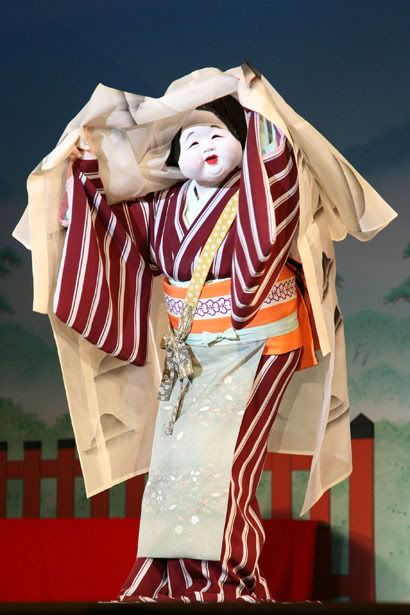
The Long-Nosed Goblin of Mt. Atago: Performed by the geiko of Gion Higashi. During setsubun, many people hang Okame masks (thought to bring good luck), like the one above.

According to ancient Chinese legend, a man-eating mountain-dwelling beast called the nian (年) silently slipped in and out of houses, preying on unsuspecting villagers. In time, people learned that loud noises and the color red seemed to repel the monster, and began to protect themselves with explosions, fireworks displays and the use of the color red in their homes and villages. Eventually these customs evolved into the first Chinese New Year celebrations. Even the kanji for Guò nián (Simplified Chinese: 过年; Traditional Chinese: 過年), which means to celebrate the new year, literally means 'the passing of the nian beast".

The legend of nian and the traditions adopted to repel him became so intwined with the idea of the new year that, when the Japanese began using chinese characters in their writings, the kanji for the nian (年) came to mean 'year'.
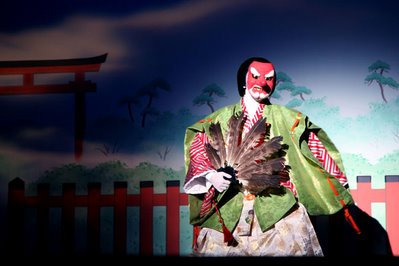
A long-nose oni (goblin, devil) mask.

In traditional Japan, the new year celebrations began with Risshun (立春) Setsubun (節分), the day before the begining of Spring (according to the traditional East Asian calendar). As with modern celebrations of the Gregorian New Year, special rituals were performed to cleanse the misfortune of the former year and drive away evil spirits in the year to come.

As in China, the celebrations were not without their hideously evil creatures. The devilish Oni were originally invisible spirits or gods which caused disasters, disease, and other general unpleasantness in the lives of humans, taking on a variety of forms to deceive (and often devour) them. The Chinese character (鬼) meaning "ghost" came to be used for these formless creatures. It was not until Buddhism arrived that Oni took on its present ogre-like form.

In Japan, these beasties were much easier to keep at bay. On this traditional New Year's Eve, the toshiotoko (man born on in the corresponding animal year of the Chinese zodiac or the head of the house) would throw pan heated soy beans out the door or at a family member wearing an oni mask yelling "Oni wa soto! Fuku wa uchi!" (Evil spirits out! Fortune (blessing) in!" The beans were believed to purify the home, driving out the spirits of sickness and misfortune. To ensure that good luck would enter, the soybeans were eaten. In some areas, the number of bean one eats is the same as their age, but in some places an extra bean is added for good luck. Mamemaki, or bean throwing, still happens today.

I'm off to Kyoto to experience mamemaki myself! Happy Setsubun! Fuyu was soto! Haru was Uchi! (Out with winter! In with Spring!)

Wednesday, January 31, 2007

Shakai no Mado: Your Social Window

Transalation: Shakai no mado: Social window, society's window.

Welcome to the ever-interesting world of Japanese idiomatic expressions. I don't care how good your Japanese is, I'm betting this is something only living in Japan can teach you-until now. I doubt they covered it in Japan-go 101, but hey, I could be wrong. Here goes:

Allow me to set the scene. An innocent, enthusiastuc ALT, (AKA, Me) doing her best to be genki (energetic and entertaining) despite the fact that the temperature inside the school is zero and the teachers have decided that, since so many students have been catching colds, they should start keeping the doors and windows open (What the $#$%@%@Q@#%# ?!) As she jumps, dances, and karate-chops her way around the room, pretending to play "Simon Says" in a crude attempt to survive the bitter cold...

Student: Sensei?

Teacher: Yes?

Student: Society's window.

Teacher: Huh? (clueless).

Student: Social Window! (Trying to be discreet).

Teacher: WHAT the heck is that? Social window? What does that mean? (loud and obnoxious. If everyone wasn't listening before, they are now).

Student: It's open.

Sensei: . . . Oh...

So, what does it mean?

Friday, January 26, 2007

Road Trip: Matsumoto or Bust!

Photobucket - Video and Image Hosting
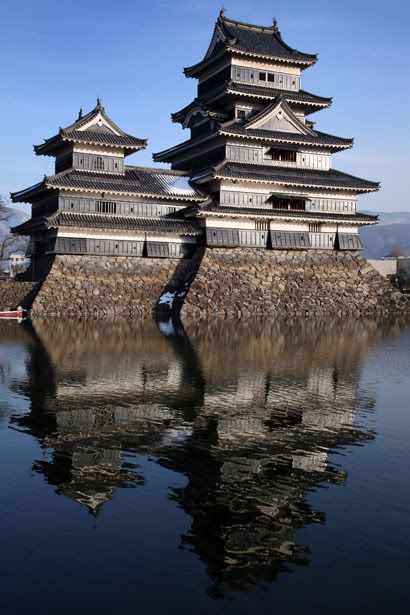
Matsumoto Castle, also known as the Black Crow for its black walls and roofs spread out like wings, is one of the four castles Japan has listed as a National Treasure. Construction of the castle, as it appears today, began in the 1580's. The Donjon, or keep, is the second oldest survivng castle structure in Japan, built in 1593. The stones that form the foundation were taken from nearby mountains and carefully piled up by crossing their longer and shorter sides. No mortar was used between the stones. This process is know as Nozura-sumi.

In a weak attempt to break our winter weekend routine (which consists of sitting directly in front of a heater or under a kotatsu)the world famous Profesora of Abbey in Ena fame and I decided to take a roadtrip up to Matsumoto Castle in neighboring Nagano. Unlike a previously attempted roadtrip in which we never actually arrived at our agreed upon destination (thanks to some outdated Japanese road signage and a Jurassic Park-like road barrier) we found our way through the beautiful, increasingly cold and snowy mountain scenery along the Gifu-Nagano border, sharing an Ipod and singing along to the likes of A Tribe Called Quest, Yui, WuTangClan, Bump Of Chicken, and Shakira.

Home-made roadtrip-commemorative purikkura!

Nestled in the snow-capped peaks of the Southern Alps, Matsumoto castle would have a stunning backdrop if not for all the cell phone towers, pachinko parlors and concrete that seem to have it under seige. Although it's flat-land position seems strategically weak, whatever the "black crow" castle lacks in defensive strength, it makes up for in aesthetics: unique black walls, gracefully upturned roof tips, and a classically curved, crimson bridge leading over a reflective moat. It's hard to believe that shortly after the Meiji Restoration of 1868, the new Japanese government was so desperate for cash that it decided to demolish the castle to sell any timber or iron fittings they could salvage as scrap. Sadly, many other castles met this fate, being too high maintenance with no modern military value. Luckily, a local buisnessman named Ichikawa Ryozo rescued Matsumoto Castle, helping local citizens to purchased the castle in 1878.

Who is that hooded slurper? What excellent chopstick form!
After struggling to survive the climb up and the steep, irregularly spaced stairs in dangerously slippery, over-sized slippers, were rewarded with beautiful blue skies for a few post-soba slurpping pictures. Did I mention that there's an excellent soba shop convieniently located near the castle entrance? The kitsune soba is meccha umai (crazy good!), and the hot soba cha (tea) helped speed along the thawing process after nearly freezing in the frigid interior of the castle. You can read more about our little adventure at The World or Bust.

Wednesday, January 24, 2007

My Cambodian Family : Battambang

Photobucket - Video and Image Hosting
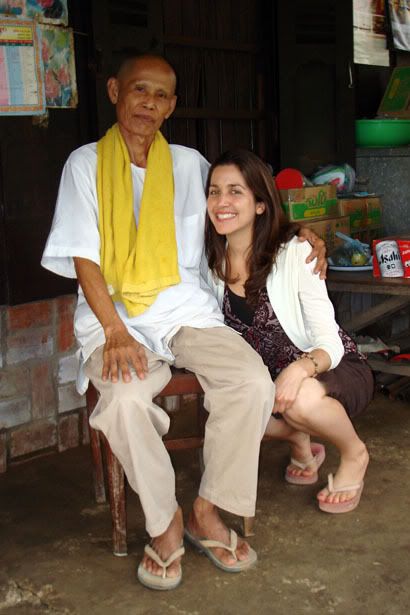
Ratha's father, Papa Kim, and I.

Remember Ratha? We've kept in touch since August, and when I told him I was coming back to visit, he was kind enough to invite me to meet his family and stay at his home.

Ratha and his father outside their home.


Like father like son!


My new sister, Srey Mom, and I chatting away over something delicious.


Concentrate! I`m showing off my ability to count in Khmer.


Now we`re laughing at my inability to do anything else in Khmer. Thank God laughter is universal!


Saturday, January 20, 2007

Where Did The Year Take You?

A few of my favorite images of 2006. It was a very good year.

Here's where 2006 took me:

1. Ena, Gifu, Japan ( Of course. I live here!)
2. Nagoya (Unavoidable stop on the way out of the country, or to Kansai).
3. Kyoto (Matsuri, geisha dances, and any other excuse I can find).
4. Osaka (To visit Shingo and Yuko-chan!)
5. Sapporo, Hokkaido, Japan (Yuki Matsuri, the snow festival 2006)
6. Otaru, Japan (Quick sushi fix)
7. Hanoi , Vietnam
8. Saigon/ HCM, Vietnam
9. Sapa, Vietnam (Where I started the new year).
10. Bac Ha, Vietnam
11. Taipei, Taiwan
12. Kuala Lumpur, Malaysia
13. Phnom Pehn, Cambodia
13. Siem Reap, Cambodia
14. Battambang, Cambodia
15. Cleveland, Ohio (for my best friend's wedding).

I wonder where 2007 will lead...