Tuesday, February 13, 2007

Happy Valentine's Day!

Pucker up! A very young Donald Rumsfeld playing a Japanese game with a young maiko during President Ford's trip to Japan in 1974.

Here's to two things I love about Japan: Geiko and...

Purikkura!

Sunday, February 11, 2007

Obake

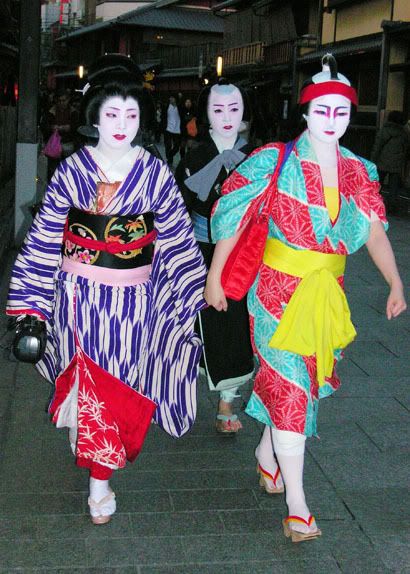
Two geiko dressed as a town girl and man from the Edo period.

Risshun Setsubun, the parting of winter and spring, was traditionally somthing like a New Year's Eve and Halloween combined. To start the new year off right, Japanese people performed a number of rituals to cleanse the old year of evil and misfortune, and keep it away in the year to come. People even dressed up in costumes to trick the evil spirits into thinking they were someone, or something, else.

This tradition carries on in the hanamachi, or geiko districts, of Kyoto. Once a year, geisha dress up in costumes and entertain their customers as Disney Princesses, Playboy Bunnies, samurai...Whatever they wish.

A feudal princess and samurai.

Photobucket - Video and Image Hosting
Remember Mamechika? Here she is as a geiko (purple kimono), enjoying Setsubun with her boombox (^-^)/
Photobucket - Video and Image Hosting
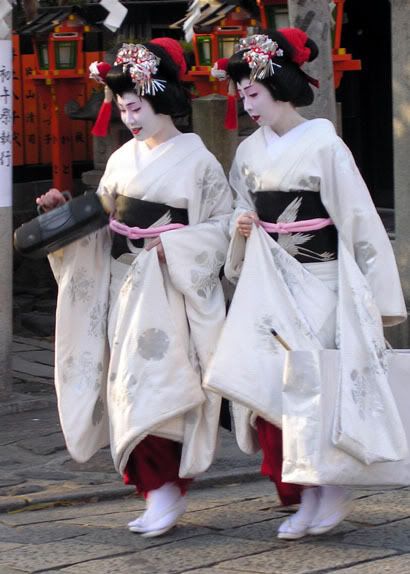
Geiko dressed in white wedding kimono.

Saturday, February 10, 2007

More Scenes from Setsubun

The maiko of Gion Higashi, in order of rank: Masayo, Tsunemomo, Umeha, Kanoaki, Miharu.

A priest summons the maiko of Gion Higashi (one of Kyoto's five hanamachi, or geiko entertainment districts) to the stage of Yasaka Shrine to be blessed before the mamemaki (bean-throwing) ceremony.

Before the mamemaki ceremony, Gion's Taiko group takes the stage.

Mission Mamemaki accomplished! The girls make their exit.

The mix of ancient tradition and ultra-modern technology: This is Japan!
Wednesday, February 7, 2007

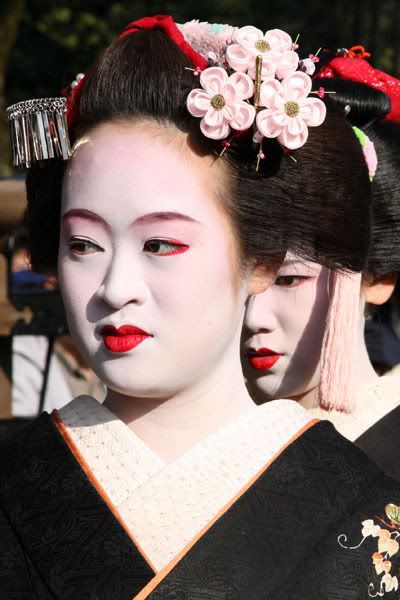
Masayo: Gion Higashi

Photobucket - Video and Image Hosting
Masayo, the highest ranking maiko of Gion Higashi (one of Kyoto's five geiko entertainment districts), wearing the special hanakanzashi (flowered hair ornament) for February. The plum blossoms celebrate the end of winter and the coming of spring.

Monday, February 5, 2007

Tsunemomo and "Drink-Driving"?

Tsunemomo, Masayo, and the maiko of Gion Higashi descending from Yasaka Shrine after the Mamemaki (bean throwing) ceremony.

Japanese technology never ceases to amaze me, nor does unavoidable deterioration of even native English speaker's language skills after a prolonged stay in Japan-land. Case in point: The presumably foreign author's (Justin McCurry) repeated use of the term "Drink-Driving'". I, too, have been outside of my native English speaking habitat for quite a while, so perhaps I'm mistaken, but wouldn't the correct terms be "drinking and driving" or "drunk driving"? Does not "drink-driving" refer to actually driving a drink, as opposed to an automobile?

****UPDATE****

Drink-Driving is a perfectly correct term used in England. I apologize if I offended anyone. m(- -)m

"Motorists who flout the law by driving home after a few drinks will soon be up against a formidable foe: their cars.

Toyota is working on a system of sensors that will automatically shut down a car's engine if it thinks the person behind the wheel has had too much to drink.

Cars will use sensors on the steering wheel to measure the alcohol level in the river's sweat, the Asahi Shimbun newspaper reported. If it is too high the car will not start."

You can read the rest of the article here.
Friday, February 2, 2007

"Oni Wa Soto! Fuku Wa Uchi!"

"GOBLINS OUT! FORTUNE IN!"
Photobucket - Video and Image Hosting
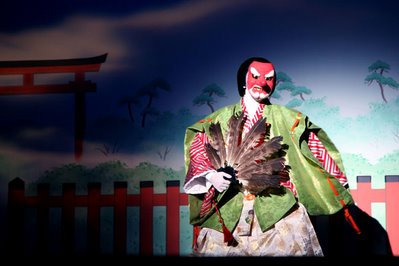
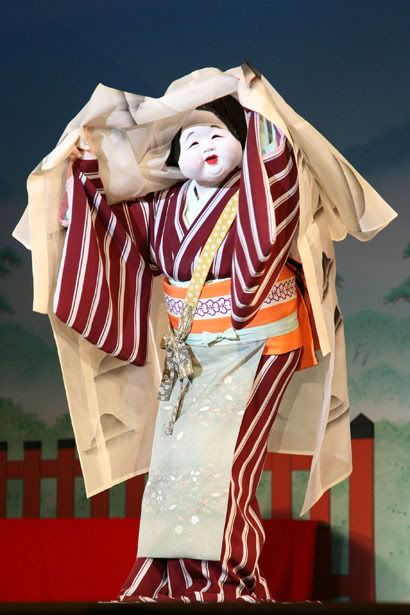
The Long-Nosed Goblin of Mt. Atago: Performed by the geiko of Gion Higashi. During setsubun, many people hang Okame masks (thought to bring good luck), like the one above.

According to ancient Chinese legend, a man-eating mountain-dwelling beast called the nian (年) silently slipped in and out of houses, preying on unsuspecting villagers. In time, people learned that loud noises and the color red seemed to repel the monster, and began to protect themselves with explosions, fireworks displays and the use of the color red in their homes and villages. Eventually these customs evolved into the first Chinese New Year celebrations. Even the kanji for Guò nián (Simplified Chinese: 过年; Traditional Chinese: 過年), which means to celebrate the new year, literally means 'the passing of the nian beast".

The legend of nian and the traditions adopted to repel him became so intwined with the idea of the new year that, when the Japanese began using chinese characters in their writings, the kanji for the nian (年) came to mean 'year'.

A long-nose oni (goblin, devil) mask.

In traditional Japan, the new year celebrations began with Risshun (立春) Setsubun (節分), the day before the begining of Spring (according to the traditional East Asian calendar). As with modern celebrations of the Gregorian New Year, special rituals were performed to cleanse the misfortune of the former year and drive away evil spirits in the year to come.

As in China, the celebrations were not without their hideously evil creatures. The devilish Oni were originally invisible spirits or gods which caused disasters, disease, and other general unpleasantness in the lives of humans, taking on a variety of forms to deceive (and often devour) them. The Chinese character (鬼) meaning "ghost" came to be used for these formless creatures. It was not until Buddhism arrived that Oni took on its present ogre-like form.

In Japan, these beasties were much easier to keep at bay. On this traditional New Year's Eve, the toshiotoko (man born on in the corresponding animal year of the Chinese zodiac or the head of the house) would throw pan heated soy beans out the door or at a family member wearing an oni mask yelling "Oni wa soto! Fuku wa uchi!" (Evil spirits out! Fortune (blessing) in!" The beans were believed to purify the home, driving out the spirits of sickness and misfortune. To ensure that good luck would enter, the soybeans were eaten. In some areas, the number of bean one eats is the same as their age, but in some places an extra bean is added for good luck. Mamemaki, or bean throwing, still happens today.

I'm off to Kyoto to experience mamemaki myself! Happy Setsubun! Fuyu was soto! Haru was Uchi! (Out with winter! In with Spring!)