Thursday, June 22, 2006

Tuesday, June 20, 2006
It's Pow Wow Time Again...
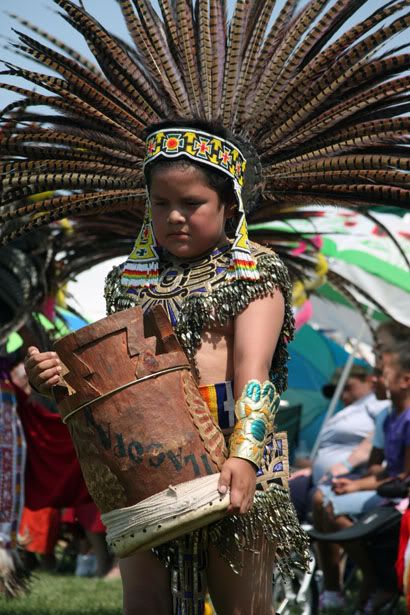
An 8 year old Aztec boy in full regalia at Cleveland's annual Edgewater Pow Wow.
Unfortunately I'm back in Japan, just in time to miss it all. Luckily I was able to make a breif cameo at Cleveland's annual Pow Wow at Edgewater Park before getting back to work after a 10 day stay in my home sweet home of Ohio, known to almost every Japanese person I meet as the Good Morning State (^-^)/.
The last time I had the privledge of attending a Pow Wow was almost 2 years ago at Mohican, before begining my new life as a JET in Japan. You can read more about Pow Wows and see a lot more pictures here and here.
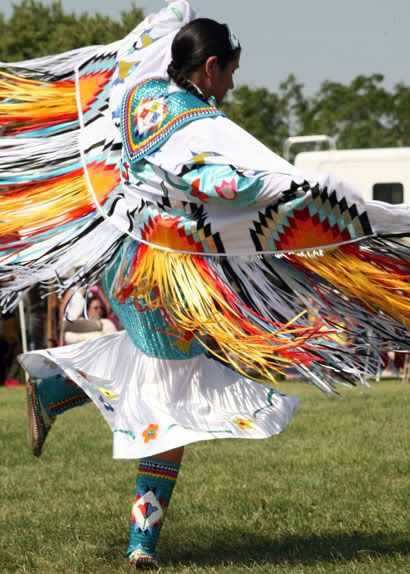
A young girl showing off her wonderfully colorful shawl during the fancy dance competition.
 An Aztec teen sporting an impressive headdress at Edgewater's annual Pow Wow.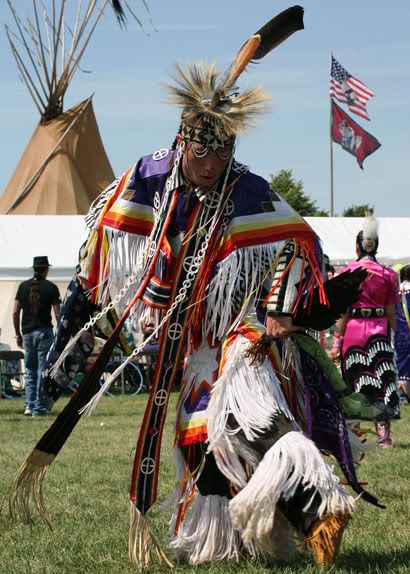
A young grass dancer tearing up the arena in some wicked regalia.
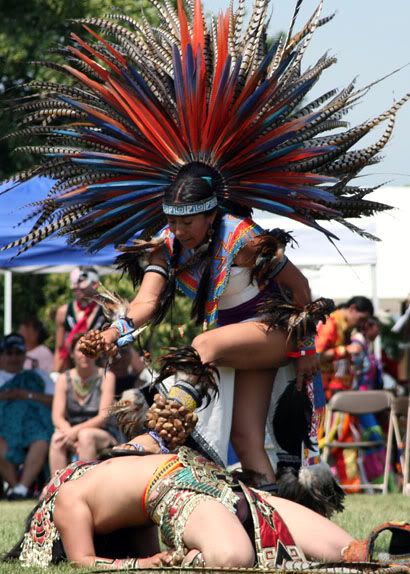
An aztec battle dance.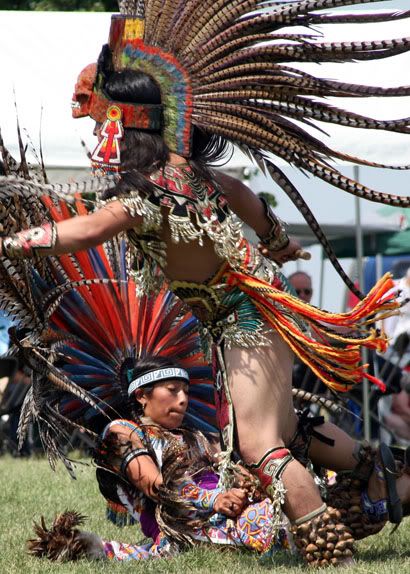
Friday, June 2, 2006
Suicide: The Enduring Way of the Samurai?
 Random picture of the day: A Pontocho geisha perfroming in Kamogawa Odori. Pontocho is one of Kyoto's 5 hanamachi, or geisha districts. This image has absolutely nothing to do with the following post. (^-^)v
Japan's total fertility rate, an indicator used for international comparisons of birth trends within individual countries, fell for the fifth consecutive year, hitting a record low of 1.25.
At the same time, suicides in Japan topped 30,000 (32,552) for the eigth straight year.
Not a good combination.
This year the number of students committing suicide reached 861, up 9.8 percent. University students accounted for more than half of the total, along with 7 elementary school pupils, 66 junior high school students, and 215 high school students .
Japan's cult suicide scene is also growing, with the number of Japanese killing themselves in groups rising steadily in recent years, from 34 in 2003 to 91 last year.
Tuesday, May 30, 2006
Mongolia and the Kama Sutra Scribble
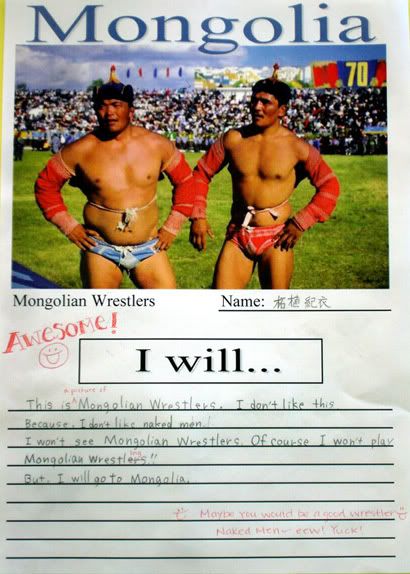
I rediscovered this gem today in a pile of old papers.
This is Mongolian Wrestlers. I don't like this.
Because I don't like naked men.
I won't see Mongolian Wrestlers.
Of course I won't play Mongolian Wrestlers
But, I will go to Mongolia.
*****
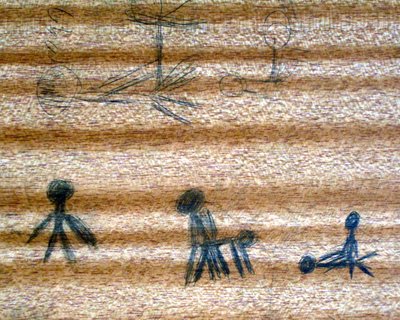
And speaking of naked men...
This comes only a week after one of the sweetest 3rd grade (9th in the US) boys in the whole school invited me to  the library during hiru yasumi (recess) to show me the school collection of Disney's books in Engish. Of course it was right about then that the crew that I usually play basketball with came looking for me, and finding me in the library, quickly set to work searching through a shelf of books. I was so impressed that they were giving up their beloved b-ball time to read, until one of them tapped me on the shoulder and pointed to a certain nether region on Michealangelo's famous statue of David in an art encyclopedia.
*****
"Melissa, what's this?"
"Hmm...Yabai." I said, trying to think of a plan of escape. The rest of the crew gathered around, waiting anxiously for my reply.
"Melissa..." he said reassuringly, sensing my fear "Ok, Ok. Doctor's word Ok."
"Doctor's word is Ok?" I asked, still stalling and hoping for a reprieve. " Ok. What is the doctor's word in Japanese?"
"Dansei!" He calmy answered, and then sensing a bit of reverse pedegogy on my part, smiled and tried to translate it into Enlglish himslef.
"Dan nan no de...Man! No no! Man- ZU! Man-zu sei...Sei...Sei..PART! Man's part!"
*****
By now, all the boys in the library were gathered around us in anticipation. We all bust out laughing. The sense of accomplishment on his face was priceless.
Eventually I told them the "doctor's word," which has and promises to lead to even more interesting eikaiwas (english conversations)...
Thursday, May 25, 2006
Miyagawa Girls: Kyo Odori
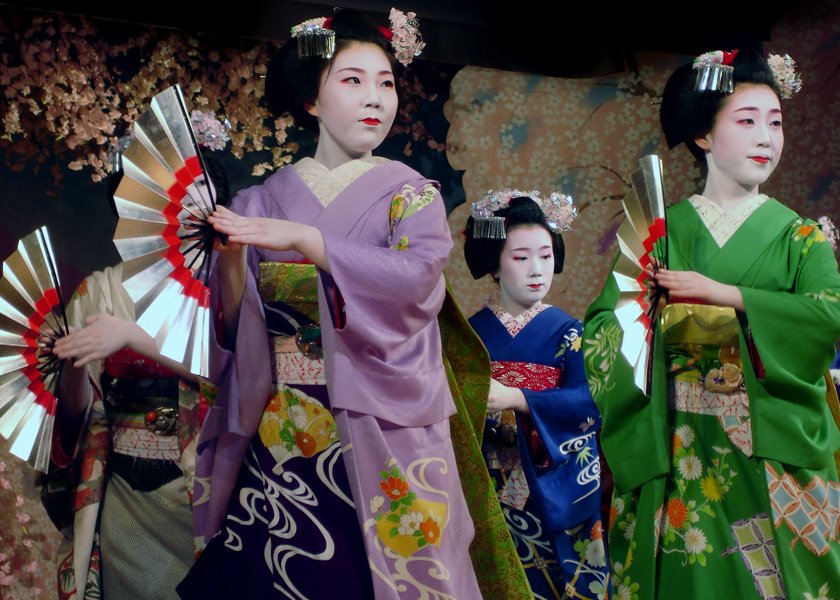 Maiko, or apprentice geisha, of Miyagawa-cho perform during the finale of this year's Kyo Odori: In purple, Fukyoshi, in green, Yasuha, in blue, Fukunao. Note the hint of red in her collar, compared to that of the other maiko -- an indication of her lower rank.
Tuesday, May 23, 2006
Peonies in Bloom : Geiko of Miyagawa
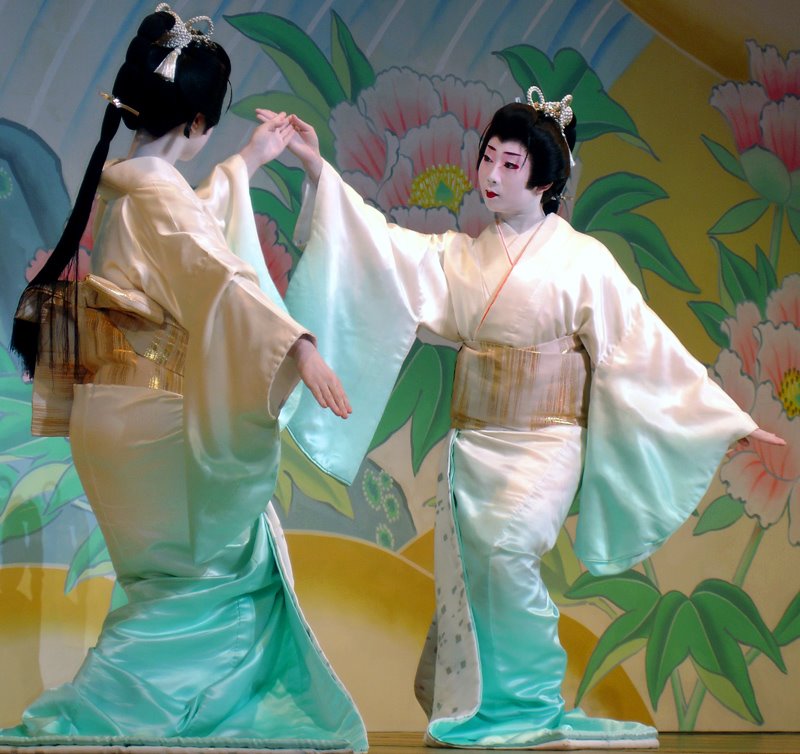 Geiko of Miyagawa-cho, one of Kyoto's five geisha districts, performing during this years Kyo Odori.
Excerpt from the 57th Annual Kyo Odori Program:
The long cold winter gives way at last to the arrival of spring in the ancient capital of Kyoto, and the Kyo Odori is always a welcome and colorful addition to this flower-filled season.
Famous for their beauty, the geisha and maiko of Miyagawa-cho grace the Kyo Odori stage to offer lively, fun, and elegant portrayals of seasonal culture, local flavor, and stories that developed in places throughout Kyoto...
Time always seems short,but we hope that the seven scenes of this year's performance, Seasonal Glories of the Capital, will provide a sense of the tradition and beauty embodied in the local performing arts.
Friday, May 19, 2006
Can You Feel the Love?

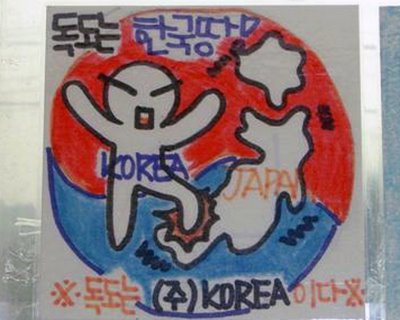
Just one of many Children's Anti-Japan drawings found lining the walls of a Korean Subway last summer. Courtesy of Toron Talker.
I remember seeing these pictures on the Toron Talker last summer and being absolutely stunned. At the time I knew even less about the tensions between Japan and the rest of Asia than I do now ( a situation of which I admit I remain almost completely ignorant, but working to understand).
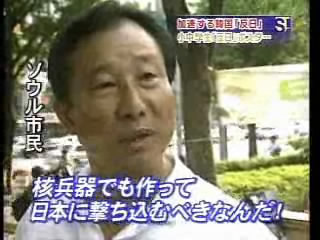 "I think we should make nuclear weapons and fire them at Japan!"A Korean man interviewed by Asahi TV.
A short time after these children's drawing surfaced, Asahi TV went to the location where they were discovered to investigate, interviewing adults and offering an interesting, if not disturbing, glimpse into a Korean classroom, and the children's views on Kim Jong Il. Korean-based Occidentalism not only reported on the program, but also provided images, translations and a video link on his website. Check it out.
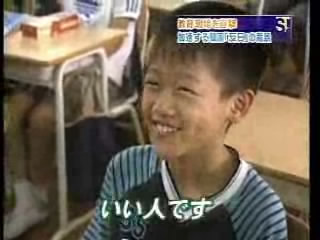 "He's a good person (Kim Jong Il)." A Korean elementary student.
Something to think about:
While the "Hating the Korean Wave" article provides insight into the tensions between the two countries, it is important to remember that less than 1% of the Japanese population had bought it back in Novemeber (360,000 copies sold). In fact, during the 2002 World Cup, Japanese spectators cheered for both Korean and Japanese teams alike, while Koreans often booed when Japan scored a goal.
When I first arrived in Japan back in August of 2004, at least 1 student in every class at each of my 16 schools asked me if I liked Yon-sama (the highly respectful name given to South Korean soap opera idol Bae Yoon Joon by his adoring Japanese fans). At first I didn't know the name, but once the teacher showed me his picture, I recognized him immediately. Star of the enormously famous (in Japan) "Fuyu Sonata," Yon-sama adorned the desktop calendars of many middle aged female teachers. His smiling face had followed me through subway stations and stared down at me from train advertisements. Both he and Choi Ji Woo, the heroine of 'Winter Sonata', can be seen on Japanese TV commercials every day.


