Monday, December 31, 2007

Nengajo: Japanese New Year's Cards

Photobucket
A brilliant up and coming graphic designer in Tokyo, Yuki Nakano designed this nengajo to welcome 2008: The Year of the Rat. The design of most nengajo includes the junishi, or Oriental zodiac animal, of the New Year.

Oshogatsu, or New Year's, is a very special time in Japan—a time for people return to their ancestral homes, spend time with their families and get in touch with their roots. Perhaps the most honored and celebrated of the Japanese holidays, Oshogatsu is a three-day event beginning with Omisoka (New Year's Eve) and lasting through the first three days of the year. Many people wear traditional clothing, like kimono, and play traditional games, such as uta garuta. Preparations begin long in advance as people clean their homes from top to bottom (known as Osouji), prepare Osechi ryori (traditional New Year's food eaten during the forst three days of the new year), and write nengajo, or New Year's greetings.


These days, many people use designs including photos of themselves or their families on their nengajo.

Much like the Christmas cards exchanged in the US and abroad, nengajo are an important part of Japan's New Year's festivities. Now an established tradition, the exchange of these New Year's greetings began in 1873, when postcards were first introduced to Japan. Today, the average family sends over a hundred nengajo to family, friends and colleagues, and businesses mail them to all their customers.


New Year's is a time for wafuku (traditional Japanese clothing) and Osechi ryori, traditional Japanese New Year's food.

Like many Japanese traditions, there is a specific nengajo etiquette code that has no equal in Western culture. While Christmas cards arrive anytime from Thanksgiving to New Year's, nengajo are expected to be delivered on January 1st, not a day before or after. Domestic mail usually only takes a day or two to be delivered, but nengajo can be posted early in special temporary mail boxes to ensure they arrive on time. Every card put into these boxes between December 15th and December 25th gets a special postmark and is delivered promptly on New Year' Day. Waiting for your bundle of postal love (they literally arrive bound together) and reading the flood of New Year’s wishes on January 1st is a cherished holiday tradition, similar to waiting for presents and opening them on Christmas.

Photobucket

When a surprise nengajo arrives from someone you have forgotten, it is always acceptable to send your greetings on January 6, reminding them to take care in the cold weather (寒中お見舞いもしあげます: kanchu omimai moshiagemasu). If someone you know has recently lost a loved one, you should not send a nengajo in observance of the family's mourning.

Of course, if you are a card-carrying gaijin, you are theoretically exempt from all of these rules. Why not surprise your friends and colleagues with your astounding nengajo knowledge and skill? The same gracious people that praise your ability to use chopsticks and poor attempts at speaking Japanese will be thrilled with the thoughtful consideration and effort, regardless of when your nengajo arrives.
Photobucket
Hand drawn by one of my students, this was the first nengajo I recieved in Japan.

Photobucket
Happy New Year, everyone! ☆明けましておめでとう☆

Saturday, December 29, 2007

An Aya Uto Christmas: Silent Night and Christmas Cake


"Super Idol" singer and actress Aya Ueto sings Silent Night for a Softbank cell phone commerical. Don't miss the classic Japanese Christmas cake at the end!


As an American raised in a predominantly ethnic Italian influenced family, I had never heard of "Christmas cake" before traveling to Japan. I'm interested in knowing which cultures celebrate Christmas with cake. Please share your traditions with us in the comment section!

Friday, December 21, 2007

"Tokyo Sanka" English Translation: 東京賛歌 : Bump of Chicken


In celebration of the recent release of Bump of Chicken's newest album, Oribital Period (chock full of good tunes like Namida no Furusato, Planetarium, Supernova, and Hana no Na.), I humbly present my very own translation of the Tokyo Sanka lyrics. If you haven't heard it yet, check out this video (orginally posted by Abbey) with some very Tokyo-core images to set the mood. (Still waiting with bated breath for the new video...)


Bump of Chicken = Best Japanese band. EVER.

*****

Tokyo Hymn (Tokyo Sanka)

It's a town with sky and earth
How is it different from the town where you grew up, I wonder?
Why can you tell the difference, I wonder?
I guess you've been taught since you came here

Things like all the lies, the cold, not being able to see the stars,
A storm of troubles
It's the revenge of things not going well, I guess
You started and quit so many here

What was it that you came here to do?
For whose sake was it?
Roads and railroad tracks are connected but... that's so but...
Jump out as you please, struggle along as you please
This town is all that you know
The drawer of your abandoned dream

Back then they were always nearby
The people you hate and like
Nowadays, do you care?
I guess you realized since you came here

No matter where a person goes
They are same as always

Separated from somebody and separated from yourself
You're alive!

Chosen as you please, hated as you please,
This town is all you have
The place where you, who can't go home, are

There are lots of lies everywhere, don't you think?
After all, when you can see the stars, you lose interest, right?
Among all the people passing one another by,
I think there are more than a few who came here
For similar reasons

What was it that you came here for?
Who was it that decided?
The earth and the sky are connected
The future and the past,too

You jumped out as you pleased, struggle along as you pleased
This town is all you know
The continuation of the dream you got back

Chosen as you please, hated as you please
This town is all you have
The place where you, who can’t go home, are
This town is all you have
The way back home to the place you grew up…


Tuesday, December 18, 2007

Jidai Matsuri 2007: Abutsu Ni

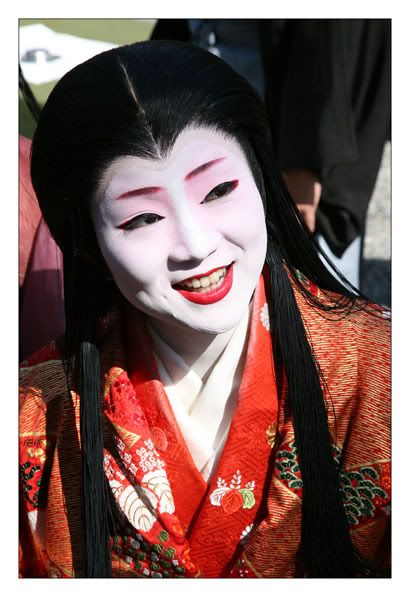
The geiko Mao of Gion Kobu peeks out from beneath her uchikatsugi as Madame Fujiwara Tamie, also known as Abutsu Ni, in Kyoto's famous Festival of Ages.

Tuesday, December 11, 2007

Jidai Matsuri 2007: Momoyama Period Style

Photo Sharing and Video Hosting at Photobucket
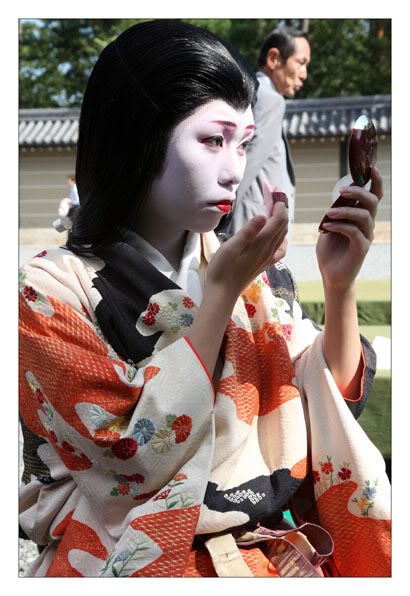
Yukako, maiko of Gion Kobu, makes a few last touches to her makeup before the procession begins.

Photo Sharing and Video Hosting at Photobucket
The geiko Suzuko flashes a stunning smile as Yodogimi, a favorite concubine of Toyotomi Hideyoshi.

Makiko, maiko of Gion Kobu, also served as a Lady-in-Waiting to Yodogimi (Suzuko).
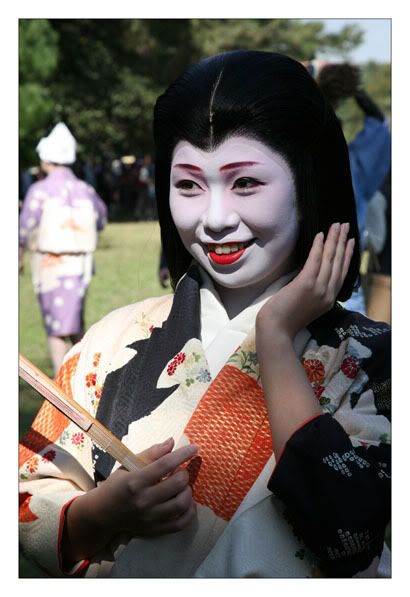
Photo Sharing and Video Hosting at Photobucket
Yukako smiles sweetly as she chats with friends.

Sakiko, another young maiko of Gion Kobu, shades herself with an elaborate fan.

Monday, December 10, 2007

Kojima Yoshio : English Teacher!


Comedian Yoshio Kojima trys his hand at teaching English...

During my last trip to Japan, I must have heard "Sonna no kankei nai" a million times -- at restaurants and izakaya (Japanese style watering holes), on the streets, and from Japanese friends. It wasn't long before I got my first taste of the speedo-clad Yoshio Kojima, a half-Brazilian, half-Japanese graduate of the prestigious Waseda University, singing and prancing around half-naked, jumping, humping, pumping his his fist towards the floor and stomping his foot. Now you, too, can enjoy this Japanese comic fad at it's finest.(Translated below).

**************************


Woman: (Hoping for help from Kojima, she reads him her homework)
Kojima: Wow, you're horrible! That's not even close!
Woman: It's been so long since I read English...
Kids: Well then, you read it!
Kojima: Shall I read it for you? That's not smooth at all, and there's so much space between the words foreigners will never understand you!
Woman: Well then, Mr. Kojima, if you would, please...
Kojima: (Brilliant English-- no translation needed!)
Woman: What language is that?
Kojima: It's English!!!

♪♪♪ Acutally I can't read English、but that doesn't matter! ♪♪♪
Hai, OPPAPI!

*(Note: Oppapi supposedly stands for "Ocean Pacific Peace". Does that explanation sounds dubious to anyone else?)

...And Japanese!

Kojima attempts to help a young boy learn a kanji, or Chinese character...

Koijima: This is the character "naku", "to cry," Ok?
Boy: Naku (to cry).
Kojima: Naku. To Cry. This is easy. Umm... (baby cries) will you be quiet? Uh... first, WHOA! Don't pull my undies down, OK?! That's dangerous!

(Begins to draw) This is a crying... Do you got it? It's a crying person. Crying. He is crying. Crying. Cryin'. Cry crai cra crr cr... CRYING!

(Kojima shows the progression of the kanji from picture to pictograph)

Boy: I still don't quite understand...
Kojima: You still don't understand? Ok, but this is how I got into Waseda...

Wow. When you explain kanji like that, it really starts to make sense! I bet naku is one kanji that boy will never forget.


Much thanks to Japan Probe for always bringing the best of Japanese TV to the blogsphere, and for being a much cooler blog than this will ever be. m(- -)m